Cancer biology informs ORR
Gleevec, Herceptin and Tagrisso succeed because they inhibit solo drivers. Solo drivers don't have many co-occurring bypass mutations, but more importantly, the bypass mutations do not cluster together.
Trastuzumab has generated $100B+ since 1998, although HER2 is neither the most frequently activated oncogene nor the most highly expressed target. Patient data explains it: HER2 is a solo driver in breast cancer, while in stomach cancer bypass alterations are more frequent and cluster together. Ask which mutations cluster with your target before the trial.
The best target I have ever seen · by Pawel Zawadzki, PhD
HER2 is not the most frequently activated oncogene, nor is it the most highly expressed drug target in cancer.
So what went right?
It is the same factor that made Gleevec so wildly successful. HER2 is a solo driver, particularly so in breast cancer.
Patient data uncovered that HER2 is a good drug target.
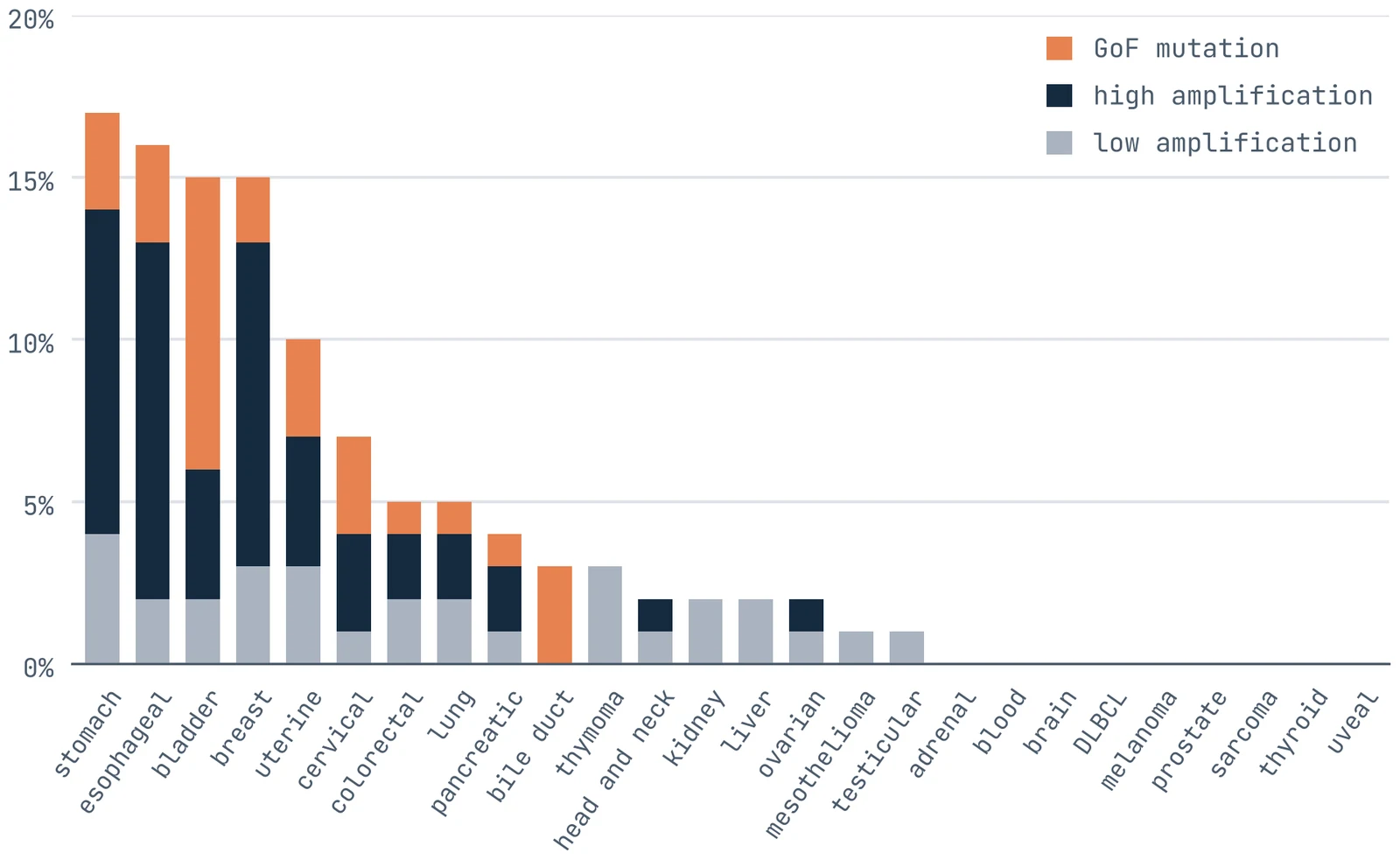
More importantly, HER2 is a solo driver in breast cancer, but much less so in stomach cancer.
| Gene | Frequency | Clustering |
|---|---|---|
| Breast, HER2-positive | ||
| EGFR | 5% | none |
| PTEN | 20% | |
| Stomach, HER2-positive | ||
| EGFR | 15% | strong, found together 4× more likely than expected (p = 0.01) |
| PTEN | 27% | |
Gleevec, Herceptin and Tagrisso succeed because they inhibit solo drivers. Solo drivers don't have many co-occurring bypass mutations, but more importantly, the bypass mutations do not cluster together.
Ask a critical question: In my target patient population, what other mutations cluster together? This can inform ORR before clinical trials and, more importantly, guide drug combinations that are key to high ORR and durability.
Use patient data to determine whether your target is an independent driver or is supported by another player.
Measure the clustering of mutations in treatment naive tumors.
Clustered mutations indicate specific combination partners that will dramatically improve the ORR and durability of your asset.
Medicines intended to work in patients should be developed with patient data in mind.