Target, indication, mechanism
Plus any internal data you can share under NDA. Public data alone is sufficient to start.
Today, go/no-go decisions on oncology programs rest on basic research and cell-line validation. We add what those cannot provide: patient molecular data, read before clinical efficacy data exist.
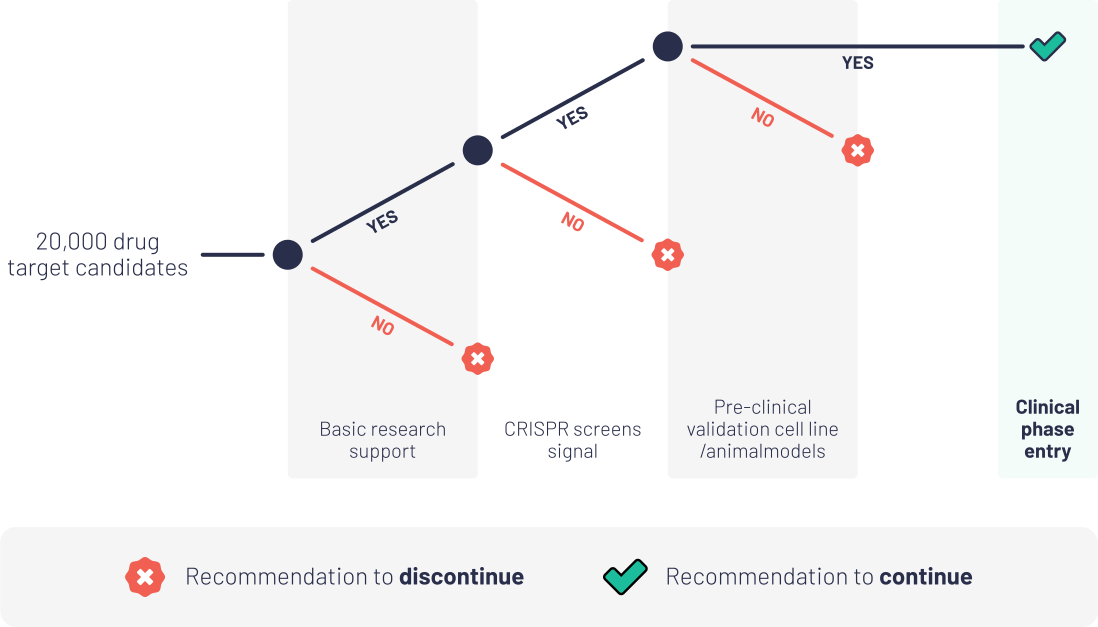
Investment and termination decisions are made on evidence from systems that do not contain a patient. The first patient-level readout arrives years and tens of millions of dollars later.
Translatability of cell-line models, clinical data for similar drugs, monotherapy activity, commercial opportunity. Each step ends in a recommendation or a conclusive experiment.
Our asset evaluation platform quantifies the probability that a program succeeds, using patient molecular data to anticipate clinical outcomes.
In retrospective validation the model predicts clinical trial outcomes from patient molecular data with 90% accuracy. Methodology and cohort details are available on request.
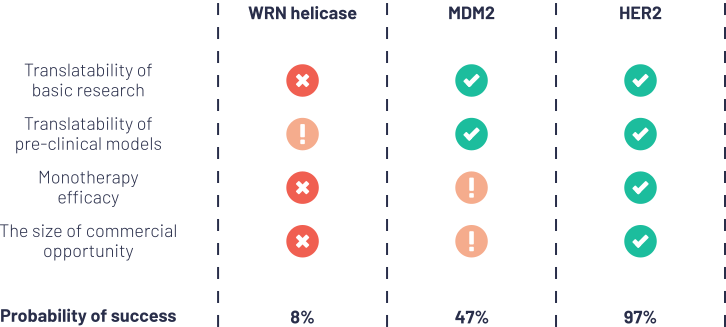
Two full target evaluation reports, public and free to read. The format is the same as a commissioned evaluation.
Plus any internal data you can share under NDA. Public data alone is sufficient to start.
Dependency evidence by tissue, co-dependencies, resistance mechanisms, patient population size and a translational-risk score. Format as in the samples above.
From scoping call to written report. Portfolio-wide reviews are scoped separately.