The tissue matters
Selecting the second-best indication might be a strategic move to avoid fierce competition. But you have to be sure it’s not getting from a frying pan into the fire.
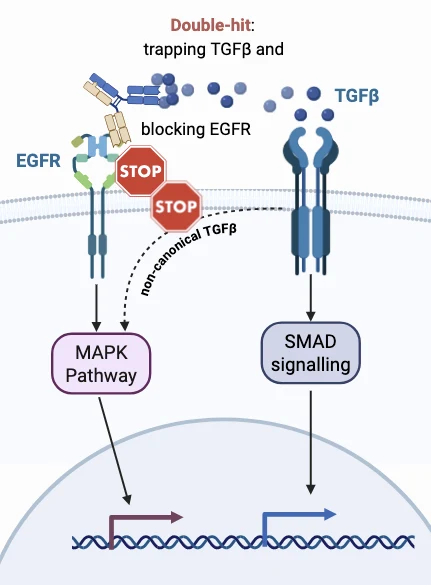
Genmab paid $8B for Merus and its EGFR × LGR5 bispecific, whose data beat BiCara’s EGFR × TGFβ product: 63% vs 54% response rate, 79% vs 62% alive at 12 months. Patient data favors Merus in head and neck cancer, only the second-strongest tissue for EGFR × TGFβ. Selecting the second-best tissue can be very expensive.
The EGFR-TGFβ competition with EGFR-LGR5 · by Pawel Zawadzki, PhD
The BiCara clinical trial is behind Merus. But more importantly, Merus’s clinical data was simply better:
vs BiCara:
Deep, AI-augmented analysis of patient data uncovered a dependency most likely undetectable in cell line models:
Selecting the second-best indication might be a strategic move to avoid fierce competition. But you have to be sure it’s not getting from a frying pan into the fire.
Data, compute, and algorithms are here. Do expect from your AI team/partner selection of the best tissue, but also the assessment of the probability of success of your competitor’s program.
Assess your and your competitor’s Probability of Success as early as possible.
Patient data identified opportunities for a combination of EGFR-TGFβ product that could further improve response rates.
Use patient data that are not coming from your clinical trial, then validate novel insights with your proprietary data.
Medicines intended to work in patients should be developed with patient data in mind.