The flawed assumption
Publicly available algorithms failed to detect the key mutation type. Investment teams mistakenly concluded WRN was an attractive target because the invalidating evidence was "absent."
More than $400M went into WRN inhibitors, with minimal benefit for patients. Gordion’s analysis of patient data found a type of WRN mutation that commonly used algorithms miss, showing that WRN is not essential for cancer cell survival. Absence of evidence is not evidence of absence.
The WRN helicase · by Pawel Zawadzki, PhD
Despite massive investment from multiple companies, clinical trials for WRN inhibitors have repeatedly shown minimal benefits for cancer patients.
This outcome highlights a stark disconnect between strong data from preclinical models and the complex reality of patient responses.
Deep, AI-augmented analysis of patient data uncovered an error produced by a commonly used algorithm:
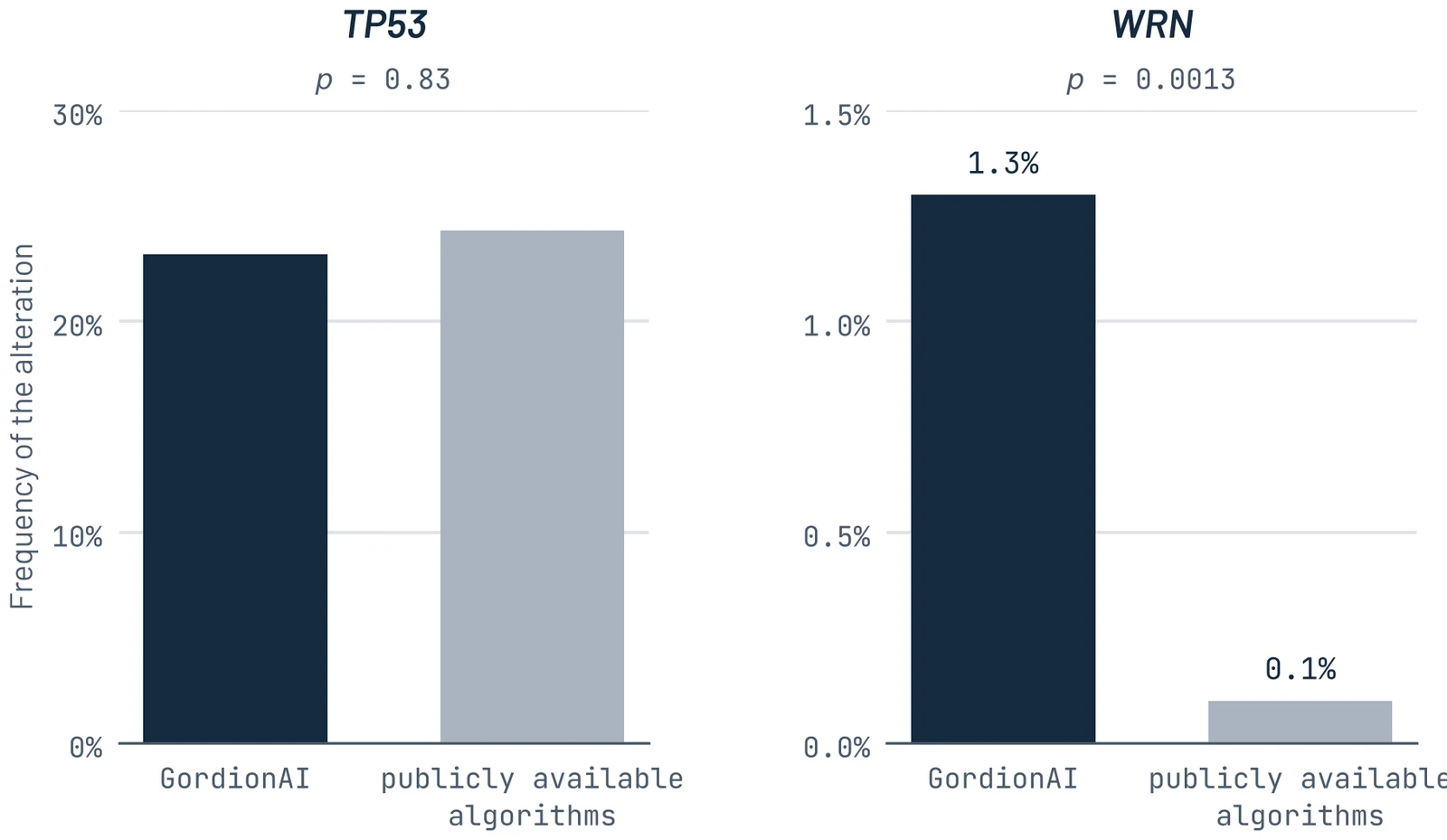
Publicly available algorithms failed to detect the key mutation type. Investment teams mistakenly concluded WRN was an attractive target because the invalidating evidence was "absent."
This is a critical lesson for all AI users: the origins of AI-generated insights can be unclear. However, even a greater challenge is assessing what your models might be overlooking.
A proper AI stack can eliminate these problems.
Patient data and well-designed AI are the only reliable way to know which targets truly matter.
Select your AI partner wisely, as this will define your future.
Medicines intended to work in patients should be developed with patient data in mind.